

From fierce competitors to narrow-minded coaches to (in all likelihood) you, Alexi Pappas can outrun just about anything.
In her new memoir “Bravey: Chasing Dreams, Befriending Pain, and Other Big Ideas”, the Olympian-turned-actress-turned-writer shines a spotlight on the things she can’t outrun — namely, the loss of her mother, Roberta North, who died by suicide when Pappas was five years old. Her mother’s absence — and the particular pain inherent in the way she died — casts a long shadow over Pappas’s life, colouring not only her sense of self, but her sense of what’s possible in a chaotic and often deeply unfair world.
Structured as a series of personal essays, “Bravey” is a lovingly rendered portrait of a family healing from irreconcilable loss, and of the myriad ways that trauma can inform the lives left behind in its wake. For Pappas, the understandable impulse to distance herself from her mother’s fate manifests as a sort of furious, desperate forward momentum that fuels her training, writing, and artistic pursuits. This seemingly bottomless well of energy ultimately carries Pappas to an Olympic berth, where she shatters her own PB and sets a new Greek national record in the process. But the bottom drops out in the aftermath of the 2016 Rio Games, when an exhausted and depleted Pappas sinks into injury and depression that eventually metastasizes into suicidal ideation. It’s here that a desperate Pappas is forced to reckon with what she has tried so long to ignore: that she is, in the end, still her mother’s daughter.
“I’ve always been afraid there is an invisible timer in my head that will one day run out and I will become like my mom,” Pappas writes. “I was terrified that I was now on a collision course with a destiny that I was desperate to avoid.”
Recovery, for Pappas, becomes an exercise in compassion — for herself, and for the mother she lost, whose talents, accomplishments, and humanity gradually come into sharper focus throughout the book. Lingering in that always-complicated space between mother and daughter, Pappas grows to appreciate the part of her mother that lives on in her; to recognize the gifts the two women share, and to appreciate the ways those gifts can be both a blessing in one life and curse in another.
Heavy subject matter notwithstanding, “Bravey” is a remarkably buoyant piece of writing. Pappas’ authorial voice leans toward the whimsical and un-self-serious. Each essay/chapter opens with one of her poems, whose straightforward diction and raggedy metre gives them the unstudied air of a diary entry. Her figurative language revolves almost entirely around food — Pappas describes toeing the start line at her debut marathon “feeling like good pasta: just slightly undercooked”. It’s a writing style that could easily veer toward trite, even facile, but Pappas manages to make it charming.
For all the radical honesty Pappas brings to her story, one thing the California native kind of diplomatically writes around is her decision to represent Greece, rather than the United States, at the 2016 Rio Games. Pappas, entitled to Greek citizenship by way of her grandmother, became a citizen in the year leading up to the Games — a presumably calculated decision that would allow the runner to take advantage of the comparatively relaxed Greek qualification standards (emphasis comparatively). Her final result in Rio had her well in the mix with the American women (Pappas beat third-ranked American Marielle Hall), rendering moot any questions of whether she could match the calibre of Team USA. Even so, there are many in the athletics community who bristle at the practice of dual-citizen athletes switching their competitive allegiance to compete under another flag, which makes Pappas’ reticence on the subject deeply understandable, if a little unsatisfying.
This, ultimately, is less about the limitations of Pappas as a writer and more about the tidy, antiseptic framework in which most narratives about athletic excellence are allowed to live. We like stories that exhort us to “be relentlessly positive” and “chase our dreams”, as if elite athletes were the walking, talking embodiment of a Lululemon shopping bag, and not a human being with a vast inner life and raw, bleeding, off-brand edges. So when Pappas describes feeling simply “proud” to represent Greece — while sidestepping any exploration of the emotional complexity inherent in competing against her home country, or the cultural disconnect one imagines must have been present between Pappas and her teammates — she isn’t obfuscating so much as following the singular narrative path available to her.
The same can be said for her heavy employment of mantra-like affirmations throughout the book — later labelled “personal laws” by her therapist, who encourages her to critically examine their efficacy in the shifting emotional landscape of her life. It turns out to be a worthwhile exercise, not only as part of Pappas’s personal recovery, but as a way of looking at the world more broadly. If you really believe that world-class athletic achievement is the result of sheer will and work ethic, how does that colour the way you think about people with disabilities, chronic illnesses, or less socially acceptable bodies? What unintended consequences could these beliefs have for us in moments of struggle or personal crisis?
“I don’t know if being a good athlete comes down to being born gifted or working hard,” Pappas writes. “We can’t know; it is always some combination of the two. I would also contend that a third factor, health, is an equally important ingredient for athletic success.”
It’s this willingness to interrogate the limits of self-determination and personal responsibility that elevates “Bravey” above the tired conventions of the inspirational athlete memoir. Her message is refreshing, urgent, and timely: you are not your accomplishments, your mistakes, your dreams. You simply are, and that’s enough.



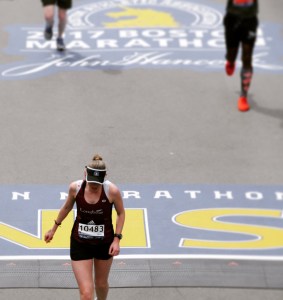 2017 broke my heart twice. First, amid the raucous din of Boylston Street, in the finisher’s chute of the Boston Marathon, a malfunctioning Garmin beeping manically on my wrist. And again, not long after that, on the corner of a quiet residential street in Toronto, orange streetlamps illuminating the last page in a bittersweet love story.
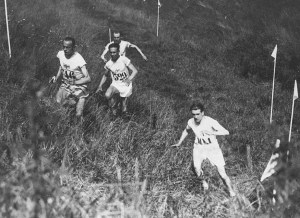 Somewhere in the past week, you may have noticed a subtle shift: the days are getting shorter, the air is getting cooler, and the leaves, in a few scattered pockets, have begun to turn. And even though the imminent pumpkin-spice-and-blanket-scarf invasion is just about upon us, I can’t help but feel — and I’m sure I’m not alone in this — that it isn’t quite fall until cross-country season begins.
 Yesterday morning, buried in my news feed among alarmist and often distressing Trump-related tweets, I came across a headline that immediately grabbed my attention:
  Ten years ago, I fell in love with St. John’s.
 When you’re a mainlander living in Newfoundland, you can’t help but feel like you’ve stumbled upon one of the world’s last unspoiled treasures; the island’s inimitable charm is oddly unknown away from her own shores. And the islanders are quick to embrace the “Come-From-Aways” like myself who choose to settle there. The result is that St. John’s, and the extraordinary people who make their lives there, never really lets you go. You leave this town with a perpetual sense of unfinished business. Newfoundland, even if you’re not a native Newfoundlander, will always call you home.
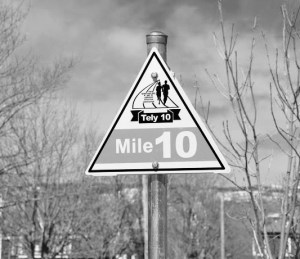 Even the course markings are no exception to this. The Tely 10 mile markers aren’t your usual sandwich boards or flags, but actual road signs – permanent, integrated fixtures in the town’s infrastructure. There’s a sense of rigidity, a characteristically Newfoundland stubbornness, to be inferred from this; here is the course, as it is, as it always has been.
 Bazeley, who ran to a ninth-place finish in last year’s race just weeks after giving birth to her second child, has been enjoying a banner year, with a strong performance in far-less-than-ideal conditions at the 10K road championships in Ottawa this spring. Her record-breaking run this Sunday, while not entirely unexpected, was one of those rare, dizzying moments of athletic transcendence. Make no mistake: the unofficial ambassador of Newfoundland athletics is a woman on the brink.
 the long slow distance