The Lost Miles: Distance running, flow states, and the key to happiness

a233dd7bf0d58de4a6069fb4d711ecc9

This week, I laced up and hit the roads again after a few solid weeks off from running (and, as you may have noticed, from writing). In years past, I’ve always adhered to a strict regimen of complete rest at the end of my season, but this year I toyed with the idea of running continuously post-marathon.

If my cross-country season is any indication, the idea turned out to be a bit of a flop. But it wasn’t a crazy thing to try: lots of great runners, my coach included, eschew complete rest in favour of a lighter day-to-day training period to recover after goal races. It’s one of those funny things in distance running that works for some athletes, and against others.

My own need for a period of complete rest wasn’t so much underscored in my cross-country race performances as it was in my easy training runs. I love running. But in the weeks that followed my fall marathon, I kind of hated it.

Running is much more than a workout for me; it’s an exercise in the maintenance of my mental well-being. A few short minutes into my run, the world around me starts to melt away. The frenetic mental processes that run at full-volume in the front of my mind for the better part of any day start to slide, very slowly, to the back of my brain. I begin thinking in a quieter, almost dreamlike state. I can lose minutes to this sort of solitary focus; on a good run, I can lose miles.

It’s an experience not unlike meditation, or even prayer.

I’m far from the first distance runner to make this observation. Boston Marathon champ Wesley Korir has spoken at length about the connection between his spirituality and his running. And this quiet, meditative state has as much to do with mental well-being as it does with performance. Just ask Canadian elite marathoner Krista Duchene, who’s advice about learning to “switch off” while racing the marathon was the difference between success and failure in my own October race.

In the day-to-day, getting “in the zone” on a mileage run can be extraordinarily useful. In psychology, this is called a flow state. Flow is a completely focused, single-minded immersion in an intrinsically rewarding task. Our emotions and impulses become channeled and contained. While the experience of flow is overwhelmingly satisfying and positive, it involves the sort of deep focus on nothing but the task at hand, wherein our emotions and even ourselves slip quietly away.

Positive psychology has recently begun to take a more in-depth look at flow states and the impact of their experience. Positive psychology is the branch of psychology concerned with the achievement of happiness and satisfaction in life, rather than on the treatment of mental illness. To put it in short, extraordinarily reductive terms, positive psychology is far more concerned with what makes people happy, rather than what makes them unhappy.

People who experience flow on a regular basis tend to report a higher overall level of happiness and satisfaction in their lives. They also appear to be more resilient in the face of difficulty or adversity. Which might explain why you so often hear runners say things like “my workout is the most relaxing part of my day” or “running is my therapy.”

Running has carried me through some tough times. It’s a comfort to know that, no matter what’s going on around me, I can always bet that 7K into a mileage run, everything will look brighter. Which is precisely why I was so resistant to taking time off this year.

In my post-marathon mileage, my body had technically “recovered” – I wasn’t dogged by any major injury or ongoing issue. But I felt run-down and worn out. I couldn’t get lost in my running and let my mind go blank, because I was too preoccupied by everything that didn’t feel quite right. Normally when I run, it feels like my mind is floating somewhere outside myself, hovering nearby in a sort of half-realized transcendence. In those weeks after the race, though, my mind was in my feet. Ask any marathoner: that’s not a place you want to be.

A few days ago, I laced up my shoes and hit the roads after just over two weeks of rest. It was evening: the sun had gone down, and though it was raining, the unseasonably warm December air was still and pleasant. I felt my mind go blank as my body slipped into that old, familiar rhythm. I ran past cars, past houses, past parks obscured in darkness, past the twinkling skyline of a city that’s never quiet, not even at night. I lost seconds, then minutes, then whole blocks. The miles slipped away.

Crossing the bridge that leads from Rosedale into St. James Town, it felt like I was flying – a feeling of total freedom and ability, and one I haven’t felt since the marathon.

There is nothing quite like two weeks off to make you appreciate what a gift it is to be able to run. So here’s to the holidays, to the year ahead, and to the lucky ones who’ll spend it chasing down those transcendental moments, and making something truly beautiful when they run.

Chase big dreams.
Running into NTRC

The last two weeks have been a lot of short, easy runs for me, punctuated by days of no running at all. And while I can say with certainty that I am recovering significantly faster post-marathon this year compared to last, I haven’t exactly been feeling 100%.

My runs generally unfold like this: I start out running a nice, easy pace, moving almost gingerly and anticipating the post-race soreness. After about half a kilometer, feeling no discomfort, my stride opens up, and I begin to run at my normal, pre-marathon pace. And within a few minutes, like clockwork, my legs start shutting down.

The dead legs have been gradually improving, but nevertheless, it’s frustrating to be out there on the roads with such a keen awareness of my own limitations. I know that recovery takes patience. I know that I’m making progress. But I’ve been missing the feeling of going out there and pushing myself.

Tonight, I got that feeling back.

I’m a solo runner. I have a great group of running friends, and a big running family, but by and large I like to log my miles alone. Running offers a sort of escape, a sacred time set aside for solitude and introspection, and I don’t often like to share that time with other people. But because of this, I sometimes forget about all the benefits that come with running with a group. Chief among them: they can shake you out of  a rut.

Check these guys out on Instagram at @nightterrorsrun

Tonight was supposed to be a nice, easy, long-ish run. Anywhere from 8-10K was the goal. But even though dead-leg-syndrome didn’t really set in, the run was feeling a bit like a slog. Until, with about 2.5K to go, I ran right into the Night Terrors.

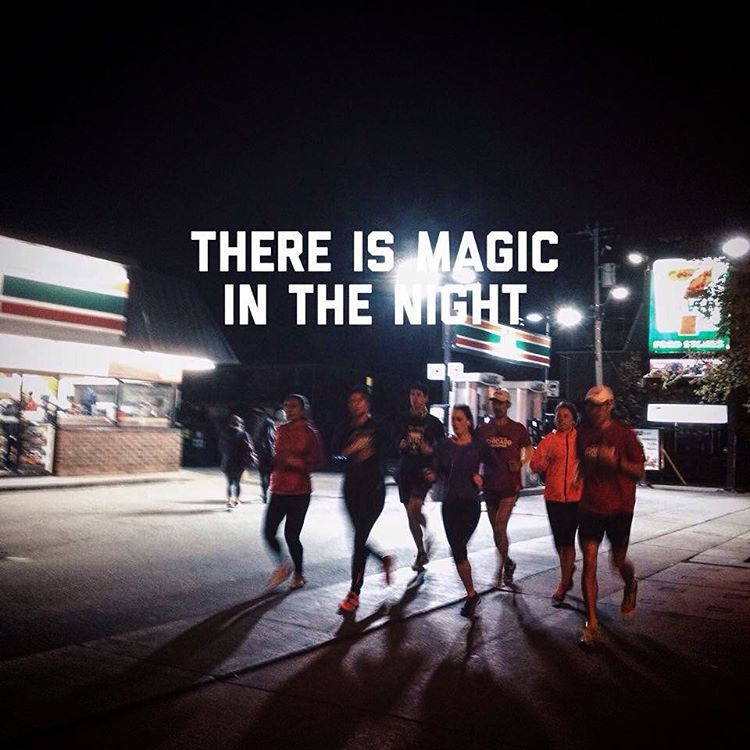
If you’ve never heard of them, the Night Terrors Run Crew is a crew (surprise!) of runners (didn’t see that coming!) who run at night (plot twist!) in Toronto’s west end (okay, that part isn’t exactly self-evident). Their group caters to all level of runner, from the seasoned and experienced to those just getting started. They also have a pretty killer Instagram.

Running into NTRC was a sweet stroke of luck tonight. In a moment, my run went from a slog to an adventure. With the help of a few familiar faces, a bunch of new ones, and a strong group to help push me along, I went from a dreary 8K to an energized 14. I felt like myself again, running tonight.

I may be a solo runner most days, but even I get a boost from running with a crew. And in a broader sense, I get a lot out of the running community in this city. I moved to Toronto three years ago, and for me, it’s only been in the past six months that the city has started to feel like home. I owe a great deal of that feeling to the amazing runner pals I’ve met through Canada Running Series and groups like NTRC.

So to all you Night Terrors: thanks for letting me tag along tonight. You helped me get some miles in the legs, shake off the last cobwebs of the post-marathon recovery, and chat with some pretty awesome runners along the way. Running into you guys by accident was pretty sweet. I can only imagine how much fun I’ll have when I run into you on purpose.

Chase big dreams.

Anatomy of a Training Journal

12106153_420127394860165_1258527820_n(1)This lovely, lazy Sunday marks one week post-marathon. The leaves are dropping, the days are getting shorter, and I’m getting my legs back under me. And even though I still have a few just-for-fun fall races on the horizon, I am starting to settle into the groove of easy running that marks the off-season.

With my big race effort in the rear view, now is the perfect time to set goals and plan for the year ahead. The marathon gave me a good sense not only of where I am, fitness-wise, but also where I’m headed.

I’ve always been a big believer in writing things down. Any goal, no matter how big or small, somehow becomes a little more attainable once I put pen to paper. I’ve kept some form of a journal since I was thirteen years old, and over the years I’ve found that most of my bigger questions are usually answered somewhere between the lines of all those mundane, day-to-day details.

Writing down goals helps to point me in the right direction; journaling helps me stay on course. So I figure now is as good a time as any to start a proper training journal.

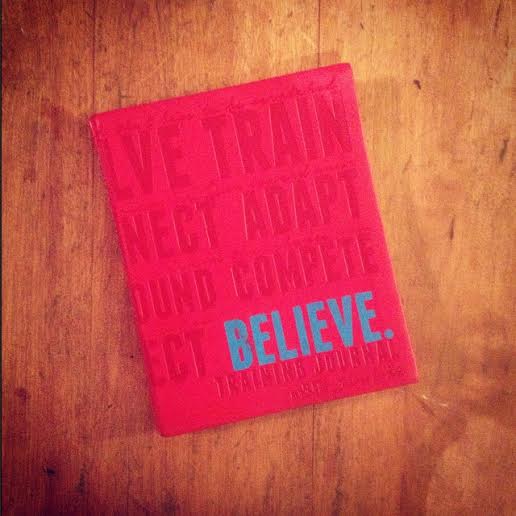
unnamedThere are a lot of great options out there if you’re in the market for a training journal. My roommate Ashley Comstock has had some pretty spectacular breakthroughs in her running this year. She loves the Believe training journal, created by two world-class runners (Lauren Fleshman and Roisin McGettigan-Dumas) to help other women chase after their athletic dreams.

Me, I took a slightly less structured approach, and went the DIY-route with my training journal. A spiral-bound notebook, some colourful pens, a few choice doodles and I’m ready to go! The appeal of a blank notebook for me is that I can chronicle my training in a more free-form fashion – with the added bonus that the whole setup only cost me three bucks!

But whether you’re following a structured journal or just jotting down workouts on bits of scrap paper, there are a few key elements you should be sure to touch on.

1. Your long-term, ultimate goal.

Use the SMART goal-setting method; your goal should be Specific, Measurable, Attainable, Relevant, and Time-bound. In my case, my ultimate goal is a strong performance at Boston in 2017. Based on my race last weekend, I selected a goal finishing time that I believe is attainable for me as a runner by that time. Once I’ve established my ultimate goal, I work backwards to determine…

2. Short-term, achievable goals.

I broke my 2016 training into two phases, with several smaller racing goals within each phase. Some of the races I selected as serious challenges, while others were picked purely because they’re fun, or because I have friends who will be running them with me. In each phase, I tried to balance the serious with the fun, to avoid feeling too run-down.

3. A racing schedule.

Plot all your races out on a calendar so that you can visualize the coming season. I would also add in any major events that might get in the way of training – things like holidays, weddings, moving, or anything else that might disrupt you usual routine.

4. A detailed weekly log.

Yes, you want to record your workouts and mileage, but it’s also important to take stock of things like the weather, any injuries you’ve been dealing with, your mental state, the time of day or route that you ran, and whether you ran alone or with company. One of the things I learned from my previous training log is that I don’t do well on long runs with other people, but I seem to thrive when doing them solo. Journaling can help you to know yourself, and set you up for success when planning your weekly training.

5. Inspiration.

Let’s face it – running can be a grind sometimes. So I like to add in little bits of motivation to help me on the tougher days. Your training journal, like your training itself, should be personal and unique to you. Fill the pages with things that give you hope and help you to believe in yourself.

And don’t be afraid to record your doubts and fears, too; when we put our anxieties into words, when we give our fears a name, we rob them of their power over us. Remember, running isn’t about being superhuman, but about how we persevere in the face of our own human frailty. So go ahead and put the whole story down on paper. I promise you, you’ll be glad you did.

Chase big dreams.